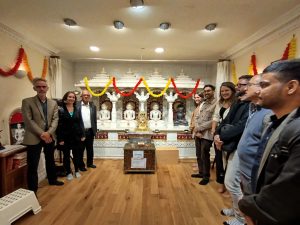
NEWS: Historic moment at the House of Commons on May 14, 2026 as the Wellcome Collection restituted 2,000 precious Jain manuscripts to the Jain community represented by the Institute of Jainology. We were deeply honoured that our Dharmanath Network in Jain studies in collaboration with the Cadbury Research Library at UoB was asked to shelter this precious heritage as we are working with the community to secure that this return has maximum impact for students, researchers, members of the Jain community, and for the general public. The Press Release of the event included an interview in the Radio 4 Sunday program of 24 May 2026, as well as articles in the Times, the Telegraph, the Times of India, the Economic Times of India, Eastern Eye, Asian Voice, the Art Newspaper, Museum Association, or the Council for Art and Law Initiatives.
Our History
The Dharmanath Network in Jain Studies was established in 2023 thanks to a generous donation from the UK and global Jain community to the School of Philosophy, Theology and Religion at the University of Birmingham.
The Network works in close collaboration with the community to enhance the societal impact of Jainism and of Jain values, especially interfaith dialogue and non-violence, through engagement between academic, religious, cultural, and political institutions.
The Network is committed to teaching Jainism and Jain values at every level of study in a way that addresses the big questions of our time, with a particular focus on interreligious dialogue, global philosophy of religion and the ethics of non-violence.
As such, it marks an ambitious collaboration between scholars in Jain Studies and scholars in Philosophy of Religion at the University of Birmingham and the activities of the Network are closely tied to that of the "Global Philosophy of Religion: Fundamental Spiritual Reality, Human Purpose, and Living Well" project, as we ensure that the voices of typically underrepresented traditions are given a proper place. This includes enhancing the fluidity between the disciplines to address the fact that relevant disciplinary boundaries are not the same ones across different traditions. Our School is especially well-designed to address this, starting by the gap between philosophy and religious studies.
The Dharmanath Network further aims to enhance the academic excellence of Jain Studies by developing the academic landscape in Jain philosophy.
The Network is called “Dharmanath” in honour of the 15th enlightened Jain teacher, the protector of a righteous religious way of living.
Our Members
. Marie-Hélène Gorisse, Assistant Professor in Jain Studies
. Christina Easton, Assistant Professor in the Ethics of Non-Violence
. Jinesh Sheth, Post-Doctoral Researcher in Jain Studies
. Aarti Gulgulia, MA student, Relating to other traditions in the philosophy of non-one-sidedness of Malliṣena’s Syādvādamañjarī (2025/26)
. Sohum Shah, MA student, Jain Contemplative Practices and the Philosophy of Living Well in Hemacandra’s Yogaśāstra (tbc)
Our activities
Click here to see our 2023/24 Report; our 2024/25 Report; and (soon) our 2025/26 Report.
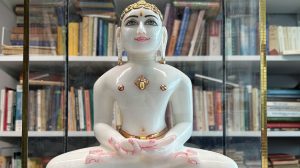
. We will shelter the 2,000 precious Jain manuscripts that the Wellcome Collection restituted to the Institute of Jainology and, in collaboration with the Jain community, we will make sure that this precious heritage has maximum impact for students, researchers, members of the community, and for the general public.
. We are home to the Paul Dundas Collection, having received the donation of Paul’s world-leading collection of books in Jain Studies after his untimely passing in April 2023 (cataloguing in process).
. We are home to part of the Marcus Banks Collection, which consists in material from his doctoral ethnographic study of the lay Jain community in Leicester and Jamnagar. This material has been organised by Chihab El Khachab (Associate Professor in Visual Anthropology, Oxford).
. We are partners of the Institute of Jainology also to increase the representation of Philosophy in the new version of Jainpedia.
. We organise regular academic events, like the conference "History, Scripture and Debate: Studies in South Asia in Memory of Paul Dundas" (September 2025); the symposium "(Non-)One-Sidedness" (September 2025); or the "Dharmanath Jain Studies Graduate Symposium" (April 2025).
. We launched the Dialogues in European Jain Studies online lecture series in collaboration with Ghent University and the Arihant Institute.
. Gorisse and Sheth are, respectively, co-founder and member of the Jaina Philosophy Research Group, which for the first time gathers researchers from Europe, India, and the States to complicate the common generalisations about Jain philosophy by exploring its complexity and historical development. Many of the members of this group are trained as philosophers and wish to see Jain philosophy enter more mainstream philosophical discussions. We find that, apart from publishing secondary sources, providing accessible translations is an important step in this direction. We also think that this kind of project is important for the Jain community since it aims to preserve its rich philosophical heritage and transmit it to the next generation of Jains both in India and the diaspora. So far, very few Jain philosophical texts have been translated into English and Jain studies is severely lagging behind Hindu and Buddhist studies in this regard. The group’s work has so far mostly focused on the various expressions of the Jain doctrine of anekāntavāda (non-one-sidedness). Our activities include a group translation of one of the most important and challenging texts on the Jain theory of non-one-sidedness, namely Akalaṅka’s Aṣṭaśatī, or The Eight Hundred, which is the first extant commentary on Samantabhadra’s Āptamīmāṃsā, or An Examination of an Authority. Next to this, Anekāntavāda: Sources and Varieties, a volume co-edited by Gorisse and Mundra, will soon be published as a Special Issue of the Journal of Indian Philosophy; and workshops are reluglarly organised, most lately the first "Jain Philosophy Across Traditions" event, focusing on exchanges with the Mīmāṃsā tradition, was co-organised by our colleagues Ana Bajželj and Anil Mundra at Riverside, California (April 2026).
. We recorded two episodes on ‘The Philosophy of Jainism’ in the Panpsycast podcast in November 2025:
https://www.thepanpsycast.com/panpsycast2/episode149-1
https://www.thepanpsycast.com/panpsycast2/episode149-2
Gallery